March 11, 2026
Marine & Offshore Tank Cleaning ServicesDubai sits at the centre of one of the world's most demanding maritime operating environments. The Arabian Gulf's salinity consistently 15 to 20 per cent above global ocean averages attacks internal tank surfaces with a corrosive intensity that operators more familiar with North Sea or Pacific routes rarely encounter. Water temperatures that regularly exceed 35 degrees Celsius during the summer months accelerate microbial colonisation in ballast tanks and freshwater systems, rendering standard cleaning intervals inadequate. And the sheer density of petroleum, chemical, and dry cargo logistics moving through UAE waters means that cargo tanks cycle through contamination and cleaning requirements at a pace that leaves no room for shortcuts.
The result is a marine tank cleaning requirement that is technically demanding, heavily regulated, and operationally time-sensitive in equal measure. Miss a cleaning interval, and you are looking at accelerated corrosion, failed port state control inspections, or a contaminated cargo load that triggers charter party disputes. Use an under-qualified contractor, and you inherit documentation gaps that surface during UAE regulatory audits at exactly the wrong moment.
This guide is a practical, technical resource for B2B decision-makers responsible for these outcomes, covering the full scope of marine and offshore tank cleaning services in Dubai, applicable UAE and international regulations, the step-by-step cleaning process, and a structured framework for qualifying and managing professional contractors in the UAE market.
Marine tank cleaning refers to the professional cleaning, degreasing, and decontamination of tanks on ships, vessels, cargo carriers, and offshore platforms. These tanks can hold fuel oil, crude oil, ballast water, cargo residues, or other industrial fluids, and each type requires a specific cleaning approach.
Offshore tank cleaning services extend this to fixed and floating offshore structures such as FPSOs (Floating Production Storage and Offloading units), drilling rigs, and subsea platforms that accumulate sludge, scale, and hydrocarbon deposits over time.
Together, these services cover a wide scope, including:
Dubai sits at the heart of one of the world's busiest maritime corridors. The Port of Jebel Ali, one of the top 10 busiest container ports globally, handles thousands of vessels every year. Add to that the offshore oil and gas activity in the UAE's federal waters, and you have a massive and constant demand for professional marine cleaning services.
What makes Dubai specifically challenging for marine operations:
This environment demands service providers who understand the local conditions, operate under strict HSE (Health, Safety, and Environment) protocols, and can mobilize quickly without disrupting vessel schedules.
Oil tanks whether on tankers, bunker vessels, or offshore facilities accumulate heavy sludge at the bottom over time. This sludge is a mix of wax, asphaltenes, water, and sediment that reduces tank capacity and can contaminate fresh fuel loads.
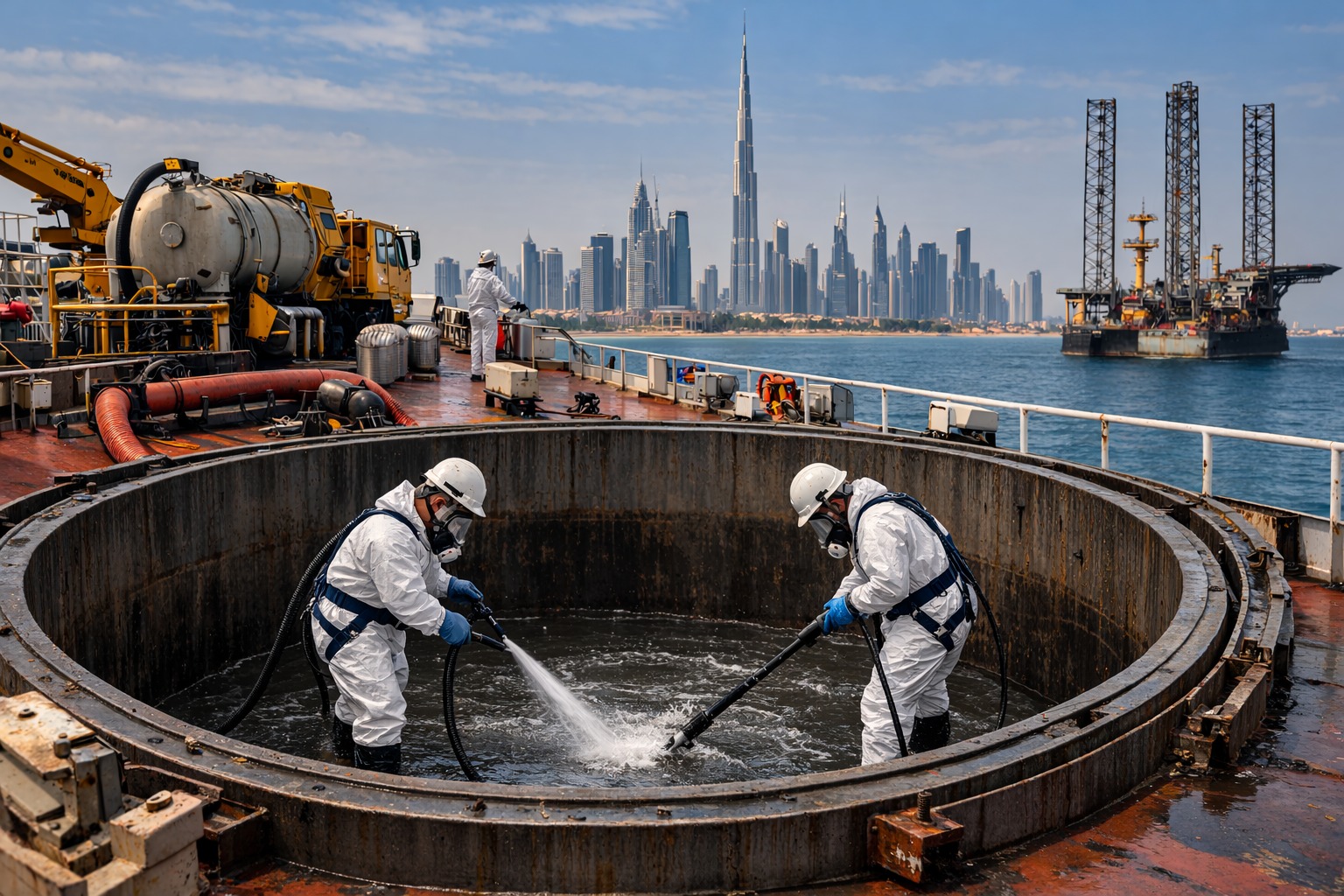
Marine oil tank cleaning involves vacuum extraction of the sludge layer, followed by high-pressure hot water jetting to break down residues on tank walls and floors. Chemical degreasers are then applied to emulsify any remaining hydrocarbon film before a final inspection confirms cleanliness to the required standard.
Switching cargo types for example, from vegetable oil to petroleum products requires thorough tank preparation. Any cross-contamination can render an entire cargo load unusable, leading to significant financial and legal liability.
Cargo tank cleaning services use certified washing procedures that meet international standards such as those set by the Oil Companies International Marine Forum (OCIMF). The washing sequence, water temperature, and chemical selection all depend on the previous and next cargo.
Beyond cargo and fuel tanks, ships have multiple other tanks requiring periodic cleaning: ballast water tanks, void spaces, cofferdam tanks, and freshwater tanks. Each has different contamination risks and cleaning requirements.
Ballast water tanks, for instance, are prone to severe corrosion and marine growth. Regular cleaning and coating inspection extend the life of the hull structure significantly.
Offshore platforms and FPSOs operate continuously, often for years at a time. During scheduled maintenance shutdowns (turnarounds), offshore tank cleaning becomes a priority task. Cleaning and maintaining offshore storage and process tanks prevents hydrocarbon accumulation, ensures safety during hot work, and keeps equipment running at rated capacity.
Given the confined-space nature of offshore tank work, all operations must be conducted under gas-free certification, permit-to-work systems, and confined space entry procedures.
Understanding the cleaning process helps you set expectations and ask the right questions when evaluating a service provider. Here is how a professional marine tank cleaning operation typically unfolds:
Step 1: Pre-Entry Inspection and Safety Assessment
Before anyone enters a tank, the atmosphere is tested for oxygen levels, flammable gases, and toxic vapours. A detailed inspection identifies the type and volume of residues, the condition of the tank lining, and any structural concerns. The safety setup includes gas monitoring equipment, ventilation systems, and an emergency rescue standby.
Step 2: Sludge and Liquid Removal
Vacuum trucks or portable vacuum units are used to extract settled sludge, liquid residues, and free water from the tank bottom. This step removes the bulk of the contamination before any washing begins and is critical for safely managing waste in compliance with MARPOL Annex I regulations.
Step 3: High-Pressure Jetting and Degreasing
High-pressure water jets (typically operating at 500 to 2,500 bar depending on residue type) are directed at all internal surfaces, walls, roof, frames, and stringers. In cases involving heavy oil or bitumen residues, hot water jetting combined with eco-safe chemical degreasers is used to dissolve and lift the contaminants.
Step 4: Chemical Treatment and Disinfection
Where microbial contamination is present, common in ballast tanks and freshwater storage, approved biocides or disinfectants are applied. For food-grade or pharmaceutical cargo tanks, food-safe sanitisers are used in line with cargo requirements.
Step 5: Ventilation and Gas Freeing
After cleaning, forced ventilation continues until the tank atmosphere is certified gas-free and fit for entry by inspectors. This step is non-negotiable before any coating, welding, or further maintenance work.
Step 6: Final Inspection and Documentation
A qualified surveyor inspects the tank visually and with any required testing equipment. Cleanliness certificates, waste disposal records, and gas-free certificates are all essential documentation for port state control and charter party compliance.
Non-compliance can result in vessel detention, port bans, heavy fines, and reputational damage that is very difficult to recover from. Working with a certified cleaning contractor who understands these regulations protects you on all fronts.
-Frequency depends on tank type and usage. Cargo tanks are typically cleaned between each voyage when switching commodities. Fuel oil tanks may require cleaning every 1 to 3 years depending on sludge accumulation rates. Ballast water tanks are usually cleaned during dry-docking cycles (every 2.5 to 5 years), though annual inspections are recommended in high-corrosion environments like the Arabian Gulf.
-Some tanks particularly those not in use during a voyage can be cleaned while the vessel is underway or at anchor. However, fuel tanks and cargo tanks are typically cleaned in port or during dry-dock to ensure safety and access. Offshore platform tanks are usually cleaned during planned maintenance shutdowns.
-These are related but distinct processes. Tank cleaning removes physical contaminants sludge, oil, scale, and biological deposits. Gas freeing refers specifically to the ventilation and atmospheric testing process that removes toxic and flammable vapors from the tank space until it is safe for human entry and hot work. Gas freeing typically follows tank cleaning but must be re-verified before any permit-to-work is issued.
-Look for ISO 9001 certification (quality management), compliance with HSE standards, MARPOL-compliant waste disposal procedures, and experience working under OCIMF guidelines. Technicians should be trained in confined space entry, atmospheric testing, and the specific chemicals used. In the UAE context, relevant trade licenses and experience with port authority requirements at Jebel Ali and other UAE ports is essential.
-Waste generated during tank cleaning, oily sludge, contaminated wash water, and chemical waste must be handled through licensed waste management channels. In Dubai, this typically means transfer to a certified waste reception facility at the port, or collection by a licensed marine waste contractor. Proper waste manifests and disposal certificates are issued as part of the service documentation.
-Cost varies depending on tank size, residue type, number of tanks, and the level of certification required. While it may seem like a significant operational cost, the alternative, corroded tanks, failed inspections, contaminated cargo, or a detained vessel, is far more expensive. Most professional providers offer a site assessment before quoting, which gives a clearer picture of the scope and cost.
Not every cleaning company has the equipment, training, or certifications to work safely on marine vessels or offshore structures. Here is what separates a reliable provider from the rest:
A good provider will conduct a pre-work survey, present a detailed method statement, and assign a qualified site supervisor throughout the operation. Communication should be clear and documentation should be thorough.
The marine cleaning industry is evolving, and some emerging technologies are worth knowing about:
Remote-operated cleaning robots are increasingly being deployed in tanks where human entry poses a high risk. These systems can navigate confined spaces, apply high-pressure water jets, and capture video footage for inspection all without requiring a person inside the tank. While still a premium option, they reduce safety risk significantly and are gaining traction in offshore applications.
Traditional tank washing generates significant volumes of contaminated wash water. Closed-loop systems recirculate and filter the wash water, drastically reducing the volume of liquid waste that needs disposal. This not only lowers environmental impact but also reduces disposal costs for vessel operators.
Regulatory pressure and environmental awareness are driving the shift toward biodegradable, non-toxic cleaning chemicals that break down naturally without harming marine ecosystems. These products meet IMO and MARPOL requirements while delivering equivalent cleaning performance to conventional chemical degreasers.
Marine and offshore tank cleaning is not a task to cut corners on. In Dubai's high-traffic maritime environment, the standards are high, the regulations are strict, and the consequences of poor maintenance are real. Whether you are managing a cargo vessel, an offshore platform, or a fuel storage tanker, clean tanks are the foundation of safe, efficient, and compliant operations.
Partnering with an experienced, certified marine cleaning service in Dubai means you get more than clean tanks; you get proper documentation, regulatory peace of mind, and a team that understands the urgency of your operational schedule.
PepTech ME provides professional marine and offshore tank cleaning services in Dubai, operating under strict HSE protocols with advanced equipment and full MARPOL-compliant waste management. Based in Business Bay, Dubai, the team is equipped to handle vessel tanks, cargo holds, offshore platform storage, and more.
To arrange a site survey or get a quote, contact PepTech ME at info@peptechme.com or call +971 04 439 66 83 and +971 55 409 1127
We are here to help you!
Reach out to us through any of these channels