April 13, 2026
Kitchen Exhausts Hood & Ducts DegreasingDubai is home to thousands of commercial kitchens, from five-star hotel galleys and busy restaurant strips in Jumeirah to cloud kitchens in Al Quoz and catering operations across Deira. Every single one of them shares the same invisible challenge: grease buildup inside the kitchen exhaust system.
Kitchen exhausts, hoods, and ducts absorb enormous volumes of airborne grease with every cooking session. Over weeks and months, this grease solidifies, restricts airflow, attracts pests, causes persistent odours, and at its worst, provides the fuel for a devastating kitchen fire.
In this guide, we cover everything you need to know about kitchen exhausts hood and ducts degreasing in Dubai: what the process involves, why it matters legally and financially, how often it should happen, and how to choose a provider you can trust. Whether you manage a high-volume restaurant, a residential villa kitchen, or a hotel banquet facility, this guide is written for you.
This is the first question most facility managers ask and it is a genuinely important one to get right.
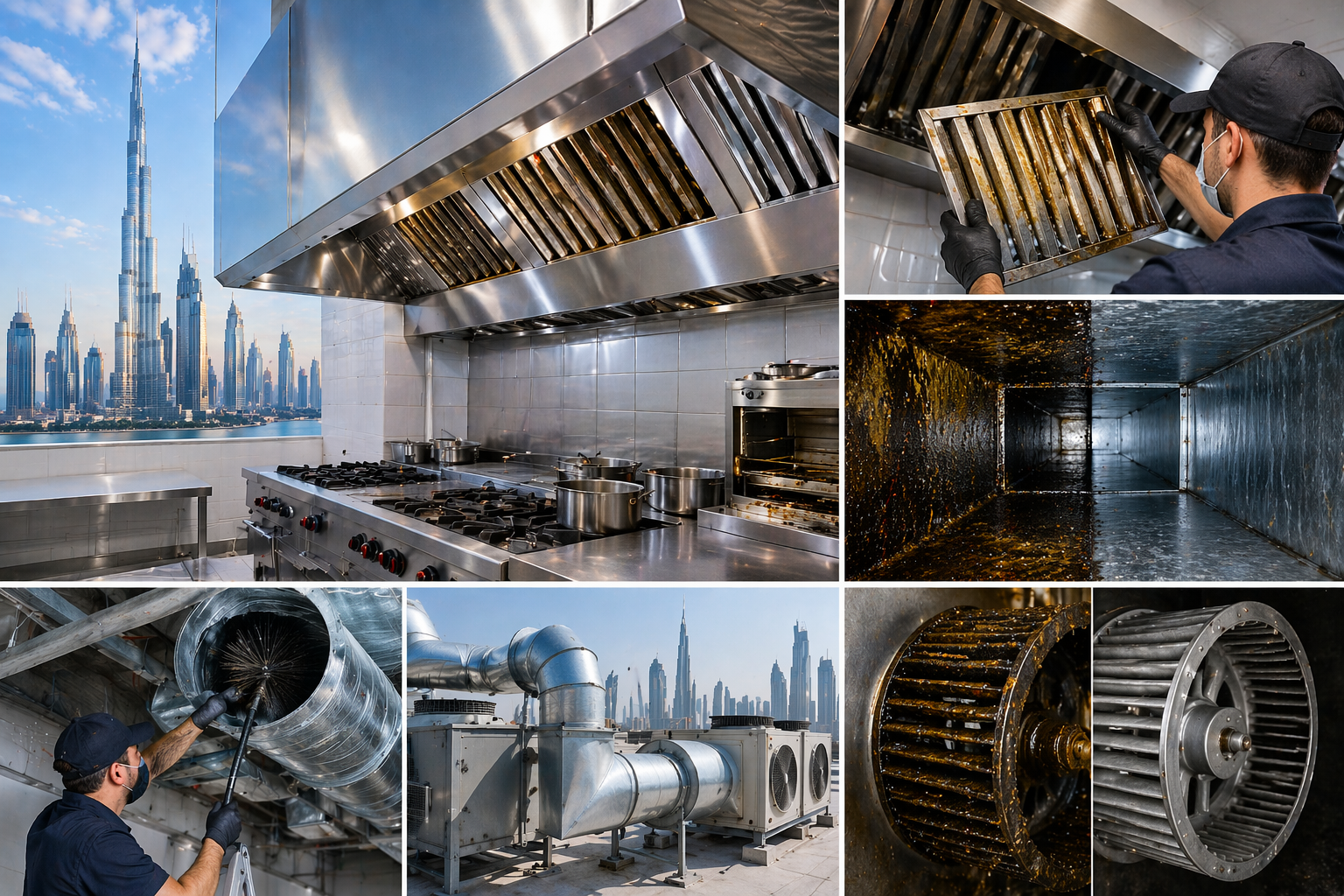
Regular kitchen cleaning deals with visible surfaces: countertops, floors, cooking equipment. Degreasing your kitchen exhaust system is an entirely different discipline. It targets the hidden infrastructure above and behind your cooking stations: the hood canopy, baffle or mesh filters, the duct network running through your ceiling and walls, and the exhaust fan motor at the far end of the system.
Surface cleaning uses water, mild detergents, and manual scrubbing to remove dirt from visible areas. Industrial degreasing in the context of kitchen exhaust systems uses specialised chemical agents, high-pressure hot water equipment, and trained technicians to break down polymerised (hardened) grease deposits inside confined ductwork.
Polymerised grease cannot be removed by wiping. It has chemically bonded to the metal surface through repeated heating cycles and requires a controlled chemical reaction to loosen it before high-pressure extraction. This is precisely why professional kitchen hood duct exhaust cleaning and degreasing is so different from what kitchen staff can accomplish with standard cleaning supplies.
Many operators think of 'the hood' as the entire exhaust system. In reality, a complete kitchen exhaust system includes several components each of which accumulates grease and each of which needs professional attention:
A complete kitchen exhaust cleaning service covers all of these, not just the visible filters. That is what a thorough kitchen exhaust system cleaning in Dubai should deliver.
Let us be direct: kitchen exhaust hood cleaning is not optional. It is a legal requirement, enforced by multiple regulatory bodies, and supported by a very clear financial logic. Here is why it matters on every level.
Fire safety authorities across the Gulf consistently identify unclean kitchen exhaust systems as one of the leading causes of commercial kitchen fires. Grease is hydrophobic and highly combustible. When it coats the inside of a duct, it creates a fuel line running from your cooking surface directly to your rooftop.
What makes this especially dangerous is that a duct fire travels fast and is almost impossible to suppress with standard kitchen fire suppression systems, which are designed to protect the cooking surface not the interior of a duct run hidden above a false ceiling.
A single commercial kitchen fire in Dubai can result in complete business closure, loss of food licence, civil liability claims, and criminal investigation under UAE fire safety law in addition to the destruction of property and risk to human life.
The Dubai Municipality's Food Safety Department requires all food establishments to maintain hygienic kitchen environments and the exhaust system is explicitly part of that environment. Inspectors check the visible condition of hoods, the cleanliness of filters, and whether operators hold documented cleaning records.
The Dubai Civil Defence (DCD) enforces fire safety compliance under UAE fire protection legislation. Commercial kitchens are inspected for fire safety readiness, which includes the condition of kitchen exhaust ductwork. A grease-saturated duct can result in a failed DCD inspection, a mandatory shutdown order, and significant financial penalties.
Pro Tip: Always request a signed completion certificate from your cleaning contractor after every service. This document is your legal proof of compliance when a Dubai Municipality or Civil Defence inspector walks in.
Beyond fire risk and compliance, there is a straightforward financial argument for regular kitchen exhaust duct cleaning. When ducts are partially blocked by grease accumulation, the exhaust fan motor works harder to pull the same volume of air through the system. This translates directly into higher electricity consumption and faster motor wear, leading to premature replacement of expensive equipment.
A clean exhaust system operates at designed efficiency, keeps the kitchen cooler and more comfortable for staff, and extends the lifespan of ventilation equipment. For a busy restaurant running 12–16 hours daily, the energy and maintenance savings from regular cleaning are measurable and significant.
The short answer: anyone who cooks commercially. And increasingly, residential occupants who cook frequently. Here is how needs vary across kitchen types.
This is the core market for professional degreasing services. Commercial kitchens generate far more grease-laden vapour per hour than any residential setting, and they operate far more hours per day. Any establishment with a commercial cooking operation requires professional kitchen exhaust cleaning services:
For all of these, commercial kitchen exhaust cleaning in Dubai is not a discretionary spend, it is a standard operational cost of running a compliant, safe food business.
Restaurants face a unique pressure: they cannot afford long service downtime during operating hours, yet they generate the heaviest grease loads of any kitchen type. Professional restaurant kitchen exhaust hood cleaning services are structured to work during off-peak windows typically late at night or in the early morning before prep begins to minimise disruption.
The type of cuisine matters significantly. Middle Eastern grills, Indian tandoor kitchens, and Asian wok stations produce substantially more airborne grease per hour than a salad bar or dessert kitchen. High-volume operations cooking over open flames or charcoal should be on a more frequent cleaning schedule than their peers.
Hotel kitchens face a dual challenge: they are large, often multi-station operations, and they operate under intense regulatory scrutiny given the scale of food production. Five-star hotel properties in Dubai typically maintain their own facility management teams but still require specialist contractors for exhaust degreasing, because the equipment and methodology required goes beyond what in-house teams are equipped to deliver.
This is a growing segment that many homeowners do not yet know exists. Residential kitchen hood cleaning services in Dubai target villa owners and apartment dwellers who cook frequently but have never had their exhaust hood or duct professionally cleaned.
In a residential setting, grease accumulates more slowly but it still accumulates. Over time, a neglected residential exhaust hood becomes a persistent source of cooking odours, reduced suction performance, and in severe cases, a real fire risk. Professional residential kitchen hood cleaning typically involves a lighter process than commercial work, but the same principles apply.
Understanding what a professional service actually involves helps you evaluate providers and set accurate expectations for your team. Here is what a thorough kitchen hood duct exhaust cleaning and degreasing process looks like when it is done properly.
A qualified technician begins with a full inspection of the exhaust system hood canopy, filters, accessible duct sections, and the exhaust fan housing. This assessment identifies the extent of grease buildup, notes any damaged or corroded components, and allows the team to plan the scope of work accurately before any cleaning begins.
For longer duct runs, technicians may use access panels or camera inspection equipment to assess internal conditions. This diagnostic step is what distinguishes a professional kitchen exhaust cleaning company from a provider offering a basic surface clean.
Baffle filters and mesh filters are removed from the hood and immersed in a concentrated, eco-friendly degreasing solution. The hood canopy itself including all interior surfaces, grease drip trays, and collection channels is treated with chemical degreaser, allowed to dwell for the appropriate contact time, then scrubbed and thoroughly rinsed.
This is the most technically demanding part of the service. Technicians access the duct interior through the hood opening, existing access panels, or the fan housing, and use high-pressure hot water extraction equipment to dislodge and flush accumulated grease from the duct walls.
Proper kitchen exhaust fan duct cleaning requires working progressively from the hood end toward the exhaust point, ensuring that dislodged grease is collected and removed not simply pushed further into the system or discharged onto the roof uncollected.
Grease collection sheeting is placed at strategic points to capture waste material, which is disposed of in compliance with Dubai's environmental regulations.
The exhaust fan housing, fan blades, and accessible motor components are cleaned of grease accumulation. The fan is both the mechanical heart of the exhaust system and a significant fire risk point when grease-coated.
During this step, technicians also inspect belt tension on belt-driven fans, check for bearing wear, and flag any mechanical concerns for the client's maintenance team to follow up on adding a preventive maintenance layer to the cleaning service.
Once all components are clean, filters are reinstalled, access panels sealed, and the system is run to verify proper airflow and function. A completion report detailing the work performed, pre- and post-condition findings, and any recommendations is issued to the client for their records.
Pro Tip: Request before-and-after photos of your duct interior as standard. This creates an auditable compliance record and helps you track grease accumulation rates useful data for adjusting your cleaning frequency over time.
Most guides do not mention this, but it is genuinely relevant in Dubai. The UAE's extreme summer heat temperatures regularly exceeding 45 degrees Celsius from June through September causes grease inside ductwork to thin and migrate further along duct runs than it would in a cooler climate. This means grease penetrates deeper into your system during summer months, making post-summer cleans especially important.
Operators in Dubai who clean twice a year should consider scheduling one of those services at the start of summer (May to June) to clear accumulated winter grease before heat causes it to spread deeper into the system. This simple scheduling adjustment can meaningfully extend the operational life of your exhaust system.
The need for kitchen exhaust duct cleaning in Abu Dhabi mirrors Dubai closely but there are some local differences worth understanding if you operate in the emirate.
Abu Dhabi's regulatory environment is overseen by the Abu Dhabi Department of Health (for food establishments) and the Abu Dhabi Civil Defence (ADCD), which enforces fire safety standards comparable to Dubai's. Abu Dhabi has been increasingly active in conducting unannounced inspections of commercial food operations in recent years, making documented cleaning records more important than ever.
From a practical standpoint, Abu Dhabi's large campus-style facilities, government complexes, hospital campuses, university canteens, and large residential compounds mean that kitchen exhaust cleaning contracts in Abu Dhabi often cover multiple kitchen units within a single site visit, which affects scheduling and pricing differently from Dubai's more fragmented restaurant market.
If you operate kitchens across both emirates, working with a single contractor who covers both Dubai and Abu Dhabi simplifies compliance management and ensures a consistent cleaning standard across all locations.
You do not always need to wait for your scheduled service. These are the signals that your kitchen exhaust system needs urgent professional attention, regardless of when the last clean took place:
If you observe grease dripping from your hood during a service period, stop cooking and contact a professional cleaning company immediately. This is not a cosmetic issue it is a live fire hazard.
The market for kitchen exhaust cleaning services in Dubai includes many providers from highly qualified, certified companies to unlicensed operators offering cheap one-time cleans with minimal follow-through. Choosing the wrong provider does not just waste money; it exposes you to serious liability if inadequate cleaning contributes to a fire or a failed inspection.
The degreasing chemicals used inside your kitchen exhaust system should be food-safe, biodegradable, and non-toxic. Ask your provider to confirm this and to share product safety data sheets if required. Any company reluctant to provide this information should be treated with caution.
Pro Tip: A provider who gives vague or evasive answers to any of these five questions should be removed from your shortlist immediately. These are non-negotiable standards for any reputable kitchen exhaust cleaning company in Dubai.
Some operators delay kitchen exhaust cleaning to reduce operational costs. It is understandable budgets are tight, and a service that happens out of sight can feel easier to postpone than one with immediate visible impact. Here is why that calculation is almost always wrong.
Professional kitchen exhaust hood and duct cleaning is not a cost it is risk management. Framed correctly, it is one of the highest-return maintenance investments a commercial kitchen operation can make.
It depends on your kitchen's cooking volume and the type of food prepared. High-volume restaurants should clean every 1 to 3 months, hotel and catering kitchens every 3 months, moderate-use cafes every 3 to 4 months, and residential kitchens every 6 to 12 months. Dubai's extreme summer heat accelerates grease migration inside ductwork, so a pre-summer clean in May or June is advisable regardless of your regular schedule.
Yes. The Dubai Municipality's Food Safety Department requires food establishments to maintain hygienic kitchen environments, which includes the exhaust system. The Dubai Civil Defence (DCD) also enforces fire safety compliance covering ductwork conditions. Non-compliance can result in fines, failed inspections, and forced closure orders.
Hood cleaning focuses on the visible canopy, filters, and drip trays directly above the cooking surface. Full duct cleaning addresses the internal ductwork running from the hood to the external exhaust point the hidden portion where grease accumulates unseen and where the fire risk is highest. A complete kitchen exhaust cleaning service covers both, plus the exhaust fan and motor.
For a standard commercial kitchen, a full service typically takes between 2 and 6 hours, depending on system size and complexity, the extent of grease buildup, and the number of duct access points. Larger hotel or institutional kitchen systems with long duct runs may require more time. Most providers schedule work during non-operational hours to avoid disrupting kitchen service.
Kitchen staff can and should clean visible filters and hood surfaces as part of their regular daily and weekly hygiene routines. However, they cannot safely or effectively clean internal ductwork, fan housing, or conduct high-pressure degreasing. Professional kitchen exhaust fan duct cleaning requires specialist equipment, chemical handling training, and confined space working procedures that are beyond the scope of general kitchen staff.
Yes, reputable providers like PepTech ME serve both Dubai and Abu Dhabi, as well as other UAE emirates. Operating with a single provider across multiple sites ensures a consistent cleaning standard and simplifies your compliance documentation management.
Professional-grade degreasing chemicals used by reputable providers are formulated to be biodegradable, non-toxic, and safe for use in food preparation environments. Always confirm with your provider that their products are food-safe, and ask to see product safety data sheets if you have specific concerns.
A comprehensive completion report should include the date and location of service, the full scope of work completed, before-and-after photographic documentation of duct conditions, the name and signature of the lead technician, any findings or maintenance recommendations, and the company's official stamp or letterhead. This document serves as your proof of compliance during regulatory inspections.
Residential kitchen hood cleaning in Dubai involves lighter grease loads and simpler exhaust systems. The process is less intensive typically covering filter cleaning, hood canopy degreasing, and a short duct clean and the service window is shorter. However, the fundamental objective is identical: a clean, safe, and fully functional exhaust system. Pricing for residential services is also significantly lower than commercial rates.
A failed DCD inspection can result in an immediate improvement notice, a financial penalty, a mandatory operational shutdown until compliance is achieved, and in repeat cases, revocation of the facility's operating licence. The cost and disruption of a failed inspection is almost always far greater than the cost of the professional cleaning service that would have prevented it.
Kitchen exhausts hood and ducts degreasing in Dubai is one of those maintenance disciplines that is easy to postpone right up until the point where something goes wrong. The purpose of this guide is to give you a clear, complete picture of what is at stake, and the knowledge to make informed decisions about your cleaning schedule, your service provider, and your compliance obligations.
The core message is simple: a professionally maintained exhaust system protects your people, your premises, your operating licence, and your reputation. It extends the life of your ventilation equipment, reduces energy costs, and ensures that when a Dubai Municipality or Civil Defence inspector walks into your kitchen, your documentation is ready and your system is compliant.
PepTech ME has been trusted by restaurants, hotels, and facility managers across Dubai and Abu Dhabi for kitchen exhaust hood and duct degreasing services. Their team of certified technicians works around your operational schedule, uses eco-friendly and food-safe products, and issues full compliance documentation after every service.
PepTech ME — Office No. 406-407, Sobha Sapphire, Business Bay, Dubai, UAE | Tel: +971 04 439 66 83 | WhatsApp: +971 55 409 1127 | info@peptechme.com | www.peptechme.com
We are here to help you!
Reach out to us through any of these channels