April 13, 2026
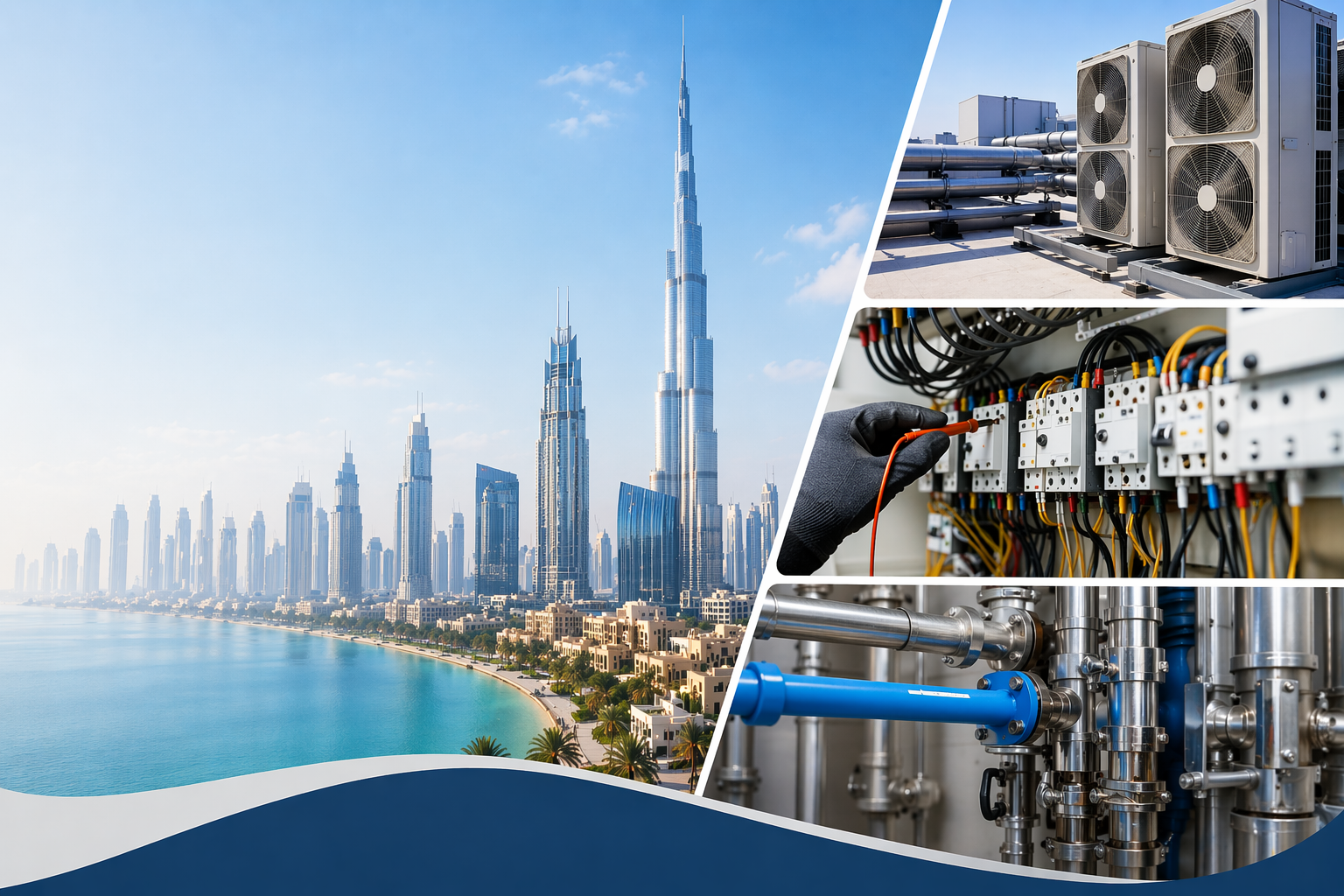
HVAC, Electrical & Plumbing Systems Services in DubaiIf you own, manage, or lease a property in Dubai, whether a villa, apartment, or commercial space, three systems quietly run your building around the clock: HVAC, electrical, and plumbing. When they work, nobody notices. When they fail, everything stops.
Dubai's extreme climate, high-rise density, and strict regulatory standards make MEP (Mechanical, Electrical, and Plumbing) maintenance not just a best practice, but a necessity. This guide breaks down everything property owners and facility managers need to know about these systems, including what they cost you when neglected, how to choose the right service provider, and what Google and AI search tools now consider when recommending local services.
MEP stands for Mechanical, Electrical, and Plumbing the three core infrastructure systems that make any building livable, functional, and compliant with UAE regulations.
In Dubai specifically, MEP systems face unique stresses: ambient temperatures regularly exceed 45°C in summer, water supply infrastructure is heavily desalination-dependent, and the Dubai Electricity and Water Authority (DEWA) enforces strict compliance standards for all electrical and plumbing installations.
Failing to maintain these systems doesn't just lead to discomfort. It can result in:
Understanding each system individually helps you know what to look for and when to call a professional.
Dubai's climate makes HVAC the most critical of the three building systems. With humidity levels soaring during summer and near-zero tolerance for indoor heat, air conditioning is not a luxury it is infrastructure.
HVAC systems in Dubai typically include split AC units, central air handling units (AHUs), chillers, fan coil units (FCUs), and ventilation networks. Each component has a defined service life, and each requires periodic maintenance to operate within its rated efficiency.
The Dubai Municipality's Green Building Regulations require that HVAC systems in new commercial buildings meet minimum energy efficiency standards. Older systems that haven't been upgraded or maintained often consume 30–40% more electricity than necessary a cost that compounds every month.
Electrical systems in the UAE must comply with IEC (International Electrotechnical Commission) standards and DEWA's technical regulations. Non-compliant installations, even minor ones can result in supply disconnection or liability in case of fire or damage.
Dubai's buildings range from 1980s low-rises with outdated wiring to smart towers with integrated BMS (Building Management Systems). Whether you're managing a legacy switchboard or a modern power distribution network, the risks of deferred electrical maintenance are real: overloaded circuits, tripped breakers, fire hazards, and equipment failure.
Professional electrical maintenance involves much more than changing fuses. It includes thermographic scanning to detect heat anomalies in switchgear, insulation resistance testing, and load analysis to prevent circuit overloading none of which can be safely performed without professional equipment and certification.
Plumbing in Dubai operates under unique pressures literally. Desalinated water supplied by DEWA has different mineral properties than groundwater, and older pipework often suffers from scale build-up, corrosion, or pressure imbalances.
High-rise buildings face additional challenges: water pressure must be carefully regulated across dozens of floors, booster pumps require periodic servicing, and drainage systems in humid conditions are prone to biofilm growth.
A functioning plumbing system isn't just about running taps. It includes leak-free supply lines, properly vented drainage, functional water heaters, and correctly maintained storage tanks each of which connects directly to health, water efficiency, and regulatory compliance.
Types of HVAC Systems Used in Dubai Properties
Dubai's property market spans a wide variety, and so do the HVAC configurations:
Each system type has different service requirements, different failure modes, and different cost profiles. A reliable HVAC service provider in Dubai should be capable of working across all of these not just standard split units.
Don't wait for a breakdown in July. Watch for these early warning signs:
If you're experiencing two or more of these simultaneously, the system needs professional diagnosis not just a filter clean.
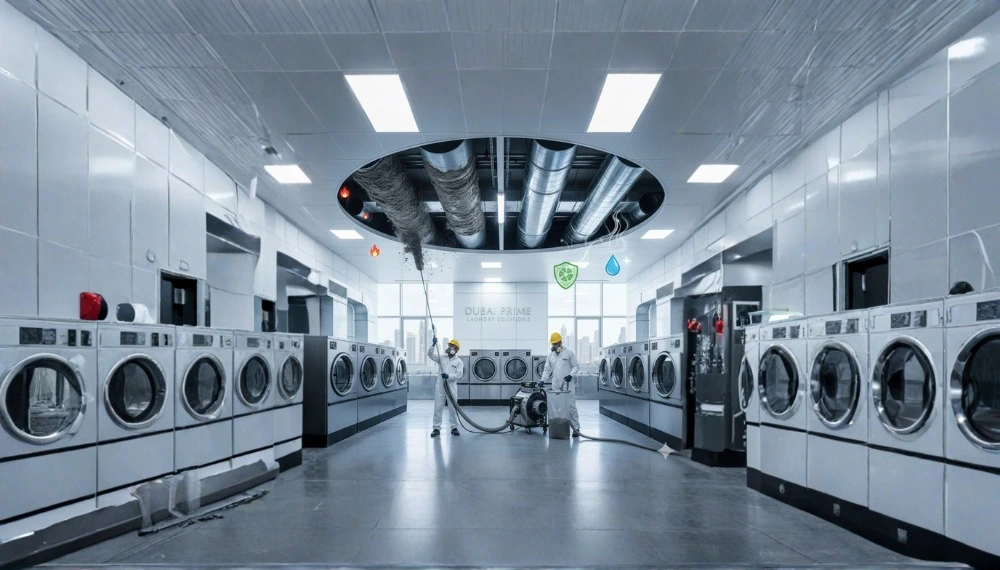
Duct cleaning is one of the most overlooked yet high-impact maintenance tasks in Dubai buildings. Ducts that haven't been cleaned accumulate dust, sand particles, allergens, and in humid conditions, mould spores, all of which are then distributed throughout the building every time the system runs.
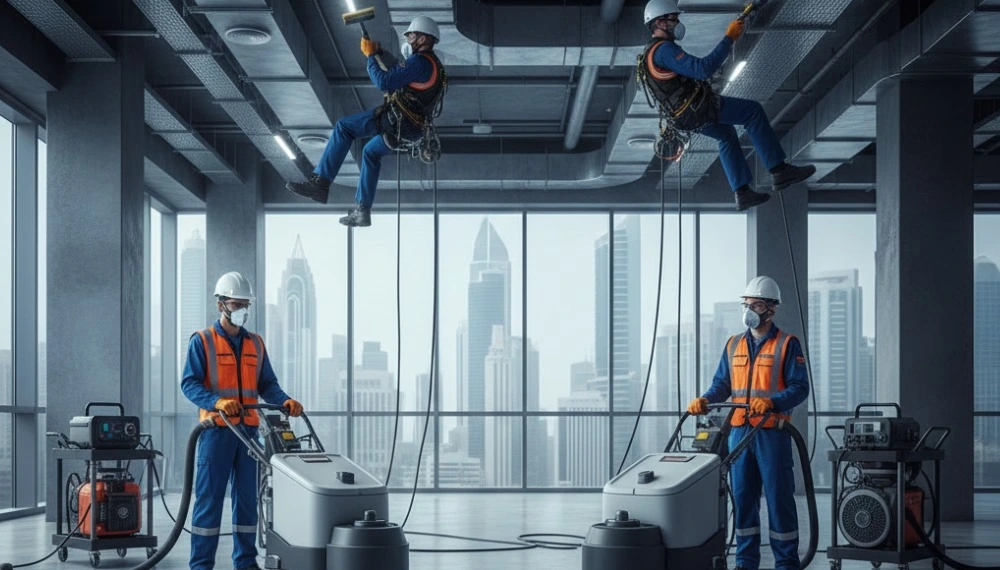
The Dubai Municipality recommends periodic duct cleaning as part of indoor air quality management. Beyond compliance, clean ducts directly improve air quality, reduce energy consumption, and extend compressor life. Professional HVAC duct cleaning in Dubai involves mechanical agitation, high-powered negative pressure vacuuming, and EPA-approved sanitizing agents.
This is especially critical in buildings with central AHU systems, where a single contaminated duct network affects every zone the system serves.
Residential Electrical Services in Dubai: What's Included
Home electrical services in Dubai go well beyond fixing a tripped breaker. A qualified residential electrical service includes:
For villas and older apartments, it's worth scheduling a full electrical audit every 3–5 years. Many properties in older communities like Jumeirah, Mirdif, and Deira have wiring that predates current DEWA standards.
Commercial electrical installations are significantly more complex and governed by a stricter compliance framework. Key components include:
MV/LV switchgear installation and maintenance
Power distribution panel (DB) installation
UPS and backup power systems
BMS integration for smart buildings
Lighting control and energy management systems
Cable tray and containment installation
All commercial electrical work in Dubai must be approved by DEWA and carried out by engineers certified under the authority's technical review process. Shortcuts here don't just risk fines they risk lives.
This is one of the most common questions facility managers ask, and it's worth clarifying clearly.
Electrical maintenance is proactive. It involves scheduled inspections, testing, cleaning, and adjustment of electrical systems before failure occurs. It includes thermographic surveys, insulation testing, and circuit load analysis.
Electrical repair is reactive. It addresses faults that have already occurred a blown fuse, a failed MCB, damaged wiring, or faulty equipment.
The key insight: every AED spent on preventive maintenance typically saves 3–5 AED in emergency repair costs. Maintenance also prevents unplanned downtime, which in commercial settings can carry significant operational and reputational costs.
With dozens of companies offering electrical services in Dubai, the quality gap is wide. Here's what to look for:
Dubai's most frequently reported plumbing problems include:
Many of these issues develop slowly and silently. Regular plumbing inspections ideally twice yearly catch problems while they're still minor and inexpensive to resolve.
The economics of plumbing maintenance are compelling. A single concealed leak in a slab or wall can cause damage that costs tens of thousands of dirhams to remediate far more than the cost of a periodic inspection that would have detected it early.
Professional plumbing maintenance companies use thermal imaging cameras, acoustic leak detectors, and CCTV drain inspection cameras to identify issues that aren't visible to the naked eye. These tools allow precise diagnosis without destructive investigation, no unnecessary wall-breaking or flooring removal.
Beyond leak prevention, a maintained plumbing system uses water more efficiently. This matters in the UAE, where water costs are significant and DEWA has introduced tiered pricing that penalises high consumption.
Plumbing and electrical systems frequently interact. Water heaters, booster pumps, automatic irrigation systems, chiller plant rooms, and fire suppression systems all sit at the intersection of both disciplines.
When these systems are maintained by separate, uncoordinated contractors, problems at the interface often get missed or worse, create new problems when one contractor's work inadvertently affects the other's system.
An integrated MEP service provider one that manages HVAC, electrical, and plumbing under a single FM contract eliminates this coordination gap. It also simplifies vendor management, consolidates service records, and typically delivers better value through bundled contracts.
PEP Tech (Perfect Environmental Protection Technologies LLC), a division of the ISO 9001:2008 certified Perfect Group, provides integrated MEP maintenance services across Dubai and the wider UAE from its Business Bay headquarters.
PEP Tech's MEP team comprises certified engineers and trained technicians equipped with industry-grade diagnostic tools , including thermal imaging equipment, refrigerant analysers, pressure testing rigs, and acoustic leak detection devices.
Every service visit is documented with detailed reports, giving clients a full audit trail of their building's MEP health over time. This documentation is particularly valuable for commercial property managers who need to demonstrate compliance during regulatory audits or insurance renewals.
What sets PEP Tech apart is its genuinely integrated service model. Rather than managing three separate vendor relationships, clients work with a single point of contact who understands how these systems interact within their building.
PEP Tech's Facility Maintenance Division operates alongside its Specialised Cleaning Division, which includes HVAC duct cleaning and sanitising, cooling tower maintenance, and water tank cleaning, ensuring that the full lifecycle of every system is covered under one roof.
At minimum, twice per year ideally before summer (April) and after summer (October). For commercial buildings or high-occupancy properties, quarterly servicing is recommended.
The Dubai Municipality recommends periodic duct cleaning as part of its indoor air quality guidelines. While not universally mandated for all buildings, it is required under many commercial tenancy agreements and FM contracts and strongly advisable for health and efficiency reasons.
Any new installation, major modification, or upgrade to electrical panels, wiring, or distribution systems requires DEWA approval and must be carried out by a DEWA-registered contractor.
Early signs include unexplained increases in your DEWA water bill, damp patches on walls or ceilings, low water pressure without an obvious cause, or the sound of running water when all taps are off. A professional plumber with acoustic detection equipment can confirm and locate leaks without destructive investigation.
Yes and it's recommended. An integrated MEP provider reduces coordination risk, delivers more consistent service quality, and typically offers more competitive pricing on bundled contracts. PEP Tech provides exactly this kind of integrated MEP service across Dubai.
Split AC servicing typically ranges from AED 100–300 per unit depending on scope. Ducted system maintenance and chiller servicing are priced based on system capacity and access requirements. Annual MEP maintenance contracts for commercial buildings are structured based on asset count and square footage.
PEP Tech — Perfect Environmental Protection Technologies LLC
ISO 9001:2008 Certified | A Division of Perfect Group
Office 406–407, Sobha Sapphire, Business Bay, Dubai, UAE
Tel: +971 04 439 66 83 | Mob: +971 55 409 1127 | info@peptechme.com
We are here to help you!
Reach out to us through any of these channels